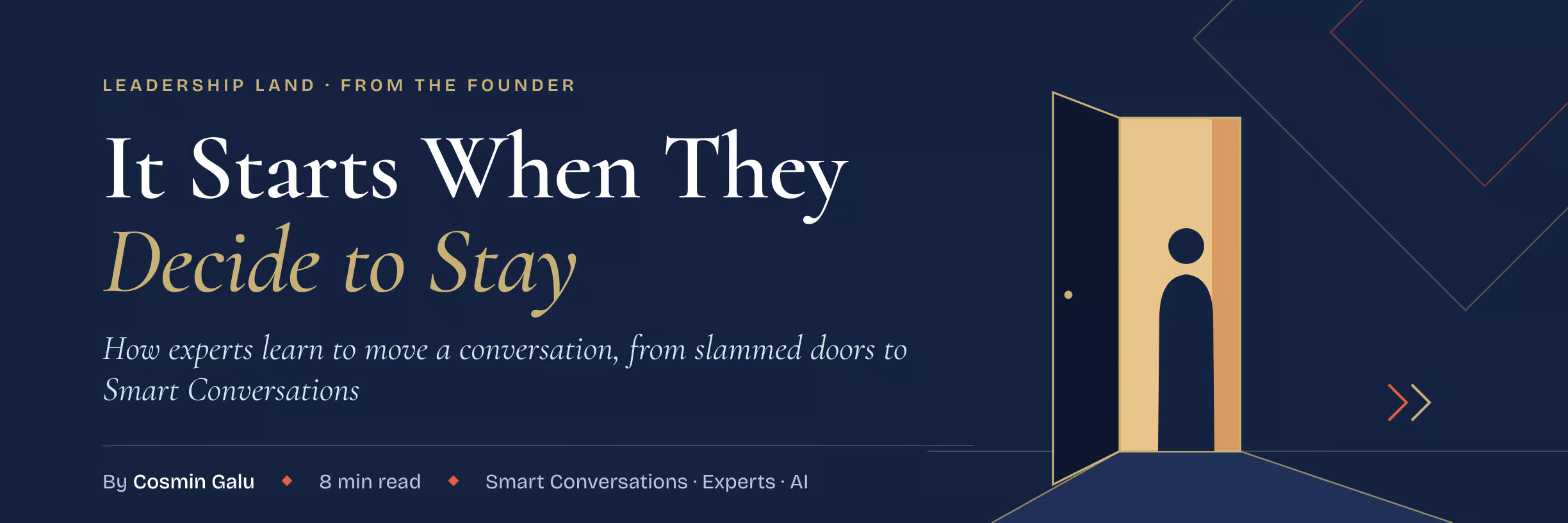
Smart Conversations was not designed at a desk. It grew, over many years, out of three places: a coaching method, a training room, and a lot of doors that were closed in my face.
I want to start with a confession. Much of what we now call Smart Conversations is a translation. I took what I learned in Co-Active coaching and asked a simple question: what happens if this posture leaves the coaching session and walks into an ordinary conversation? A meeting with a client. A debate with a colleague. A negotiation with purchasing. The answers did not come from theory. They came from what I saw, again and again, in the training room.
Where it really began: slammed doors
The roots go further back than coaching. I learned to converse very young, in the turbulent world of political volunteering in 1990s Romania. Arguments, debates and the art of conversation were not subjects we studied. They were things we did every day, mostly on doorsteps.
Door-to-door work teaches you fast. Many doors were slammed. But behind many others I found surprising conversations: people who started suspicious and ended up telling me what they actually cared about. I did not have a name for it then, but I was learning the first rule of Smart Conversations.
A conversation does not start when you begin to speak. It starts when the other person decides to stay.
What Co-Active gave me: a posture, not a script
Years later, the Co-Active coaching training gave words and discipline to what the doorsteps had taught me. What served me most in the training room was not a technique. It was the posture and the attitude the programme trains, day after day.
A few of its ideas became the backbone of how I work with professionals:
The other person is creative, resourceful and whole.
They do not need fixing or convincing from above. They need a partner who helps them think.
Listening has levels.
Most of us listen at level one, to our own thoughts and the reply we are preparing. A smart conversation moves to level two, fully on the other person, and to level three, aware of the whole room.
Dance in this moment.
A plan for the conversation is useful. Holding on to it when the other person has moved somewhere else is not.
Curiosity as a stance.
Not a question you ask, but a way of standing in the conversation.
In coaching, these serve the client’s growth. In Smart Conversations, the same posture serves something very practical: helping an idea travel from one mind to another.
Then the experts arrived
The first real demand for Smart Conversations came from a world I did not expect: IT and R&D experts. In the new AI landscape, they can no longer stay behind the code or the lab. They have to persuade internal sponsors, explain trade-offs to business owners, and win the trust of external clients.
Those of you who work with this world know the style. The conversation is direct, fact-based and efficient. That is a strength. It is also, sometimes, a challenge for the people on the other side of the table. An internal client hears a verdict where the expert meant an analysis. An external client feels lectured when the expert was only being precise.
How do you move a conversation forward in a world of experts, without asking them to stop being experts?
From intention to acceptance
The training room gave me the answer slowly. Before any technique, these extraordinary experts needed to understand two things: what drives human behaviour, and the journey an idea takes from someone’s intention to someone else’s acceptance.
A strong argument is not enough, because people rarely accept an idea only on its merits. They accept it when it fits what they need, what they fear and how they already see the problem. Data opens the door. Meaning is what makes them walk through it.
In practice, the journey has stages, and each one can break:
- 1
Intention
What I want this conversation to change.
- 2
Attention
The other person chooses to engage, not just to listen politely.
- 3
Understanding
They see the idea in their own terms, not only in mine.
- 4
Resonance
It connects to something that matters to them.
- 5
Acceptance
They make the idea theirs and are ready to act on it.
I often tell experts to imagine they are in the room with the sales team, or with purchasing. There you cannot wait at the edge of the pool and explain the water. You have to swim straight into the conversation. Some of the most beautiful and most demanding experiences of my career came from exactly this world of numbers and negotiations.
Start from what experts already do well
The biggest discovery was this: we do not have to teach experts something foreign. Most of what a smart conversation needs, they already practise every day, only on systems, data and code. Our job is to help them point those habits at people.
Once experts see this, the resistance drops. They are not being asked to become salespeople. They are being asked to bring their rigour into the room.
The most valued skill: refined curiosity
Of everything we practise, the skill participants value most, again and again, is refined curiosity. Not the polite question asked while waiting to speak. Real curiosity, disciplined enough to follow the other person where the answer lives.
Its most powerful use is navigating what we call peak experience moments. We ask clients to take us to a moment when the product, the service or the solution worked at its best for them.
In those moments, people stop reciting specifications. They show you their own image of the product: what it means in their world, the value they are really buying, the words they use for it. For an expert, this is gold. It is the difference between explaining what a solution does and understanding why it matters to the person in front of you.
When you have heard the client describe their best moment, your next proposal is no longer a pitch. It is a continuation of their story.
What we actually train
Smart Conversations works on three layers at the same time:
Structură
A clear path through the conversation, from opening to agreement, so experts always know where they are and what the next step is.
Attitude
The inner stance: curiosity over certainty, partnership over persuasion, respect for the other person’s intelligence.
Posture
How that stance shows: presence, pace, silence, the courage to ask one more question instead of giving one more answer.
We practise all three together, on the participants’ real cases, until the new way of talking stops feeling like a technique and starts feeling like their own.
Show what you preach
Experts are the most demanding audience I know. They do not accept a model because it looks good on a slide. In the room, one way or another, they ask you to show what you preach. If I talk about curiosity, they watch whether I am curious about them. If I talk about listening, they notice the moment I stop.
This is why I never bring invented examples into Smart Conversations. No made-up clients, no textbook dialogues. Whole parts of the training are built on their own cases: the project that needs a sponsor, the client who keeps saying no, the negotiation coming next week. Their examples are more complicated than anything I could invent, and far more useful.
No invented examples
No made-up clients, no textbook dialogues.
Their real cases
The sponsor, the client who says no, next week’s negotiation.
Every step, together
The trainer works alongside them, not from the front.
It is also a room for training the muscles, not only the mind. Understanding a skill takes minutes. Making it yours takes practice, feedback and another round. As a trainer, I cannot stay at the front and comment. I have to be with them at every step: in the role-play, in the pause after a difficult question, in the second attempt that finally works.
Personally, it is probably one of the most intense trainings I deliver. It is also one of the most rewarding, because by the end the room has changed.
Experts who arrived with arguments leave with conversations.
Still knocking on doors
Looking back, the line from those 1990s doorsteps to today’s training rooms is surprisingly straight. Some doors still close. But the method I built over the years is, at its heart, a way of earning the moment when the other person decides to stay in the conversation.
Experts already have the facts. Smart Conversations helps them turn facts into conversations that move people, and ideas into decisions that people make their own.